Updated
Start with accessible food and the simplest setting. Supervise, choose a safe size, separate pets around food and stop if your dog chews or tries to swallow pieces. Difficulty labels are not intelligence scores.
In this guide
Match the activity to the dog
AVSAB’s food-puzzle guide recommends considering the actions a dog enjoys, correct sizing and chewing behavior. A design that invites sniffing is different from one that rolls or requires sliding parts. Read the manufacturer’s instructions, including supervision and cleaning requirements.
| Design | Question for your household |
|---|---|
| Stationary compartments | Can you expose food at the easiest setting and supervise the pieces? |
| Rolling dispenser | Is there a safe area without stairs or places it can become trapped? |
| Food search on a surface | Can your dog search without chewing or swallowing the material? |
Consider cleanup as part of the purchase. If the parts are difficult for you to wash or inspect, you may use it less often. Measure the available floor space and compare dimensions before ordering. Photos alone do not show whether a product fits your dog’s mouth, meal or room.
Set up a first session with an easy win
- Prepare a quiet area. Give your dog space and keep other pets separate during the food activity.
- Use appropriate food. Set aside a small amount that fits the dog’s usual diet; account for it in the day’s intake.
- Make it obvious. Start with food easy to see and reach, following the product’s simplest setup.
- Demonstrate if needed. Show how a compartment works without making the dog struggle.
- Stay present. Watch how the dog uses the object, then put it away when the activity ends.
Take a note of the setup you used: which compartments were open, what food you chose and whether the dog stayed interested. Next time, repeat the successful version before considering more difficulty. There is no benefit in skipping straight to the hardest configuration.
Read the response, then change the setup
| What you notice | A useful response |
|---|---|
| The dog walks away | Check interest and timing; offer something simpler rather than insisting |
| The dog struggles to get food | Expose more food or demonstrate one easy action |
| The dog chews removable parts | End the session and reconsider whether this design is suitable |
| The dog finishes quickly | That can still be a successful activity; speed is not a failure |
Do not repeatedly take food away to test guarding. If the dog stiffens, growls or guards the activity, give space, keep children and other animals away and seek qualified help. Puzzle play is not a treatment plan for anxiety, aggression or a feeding disorder.
Try the idea before buying equipment
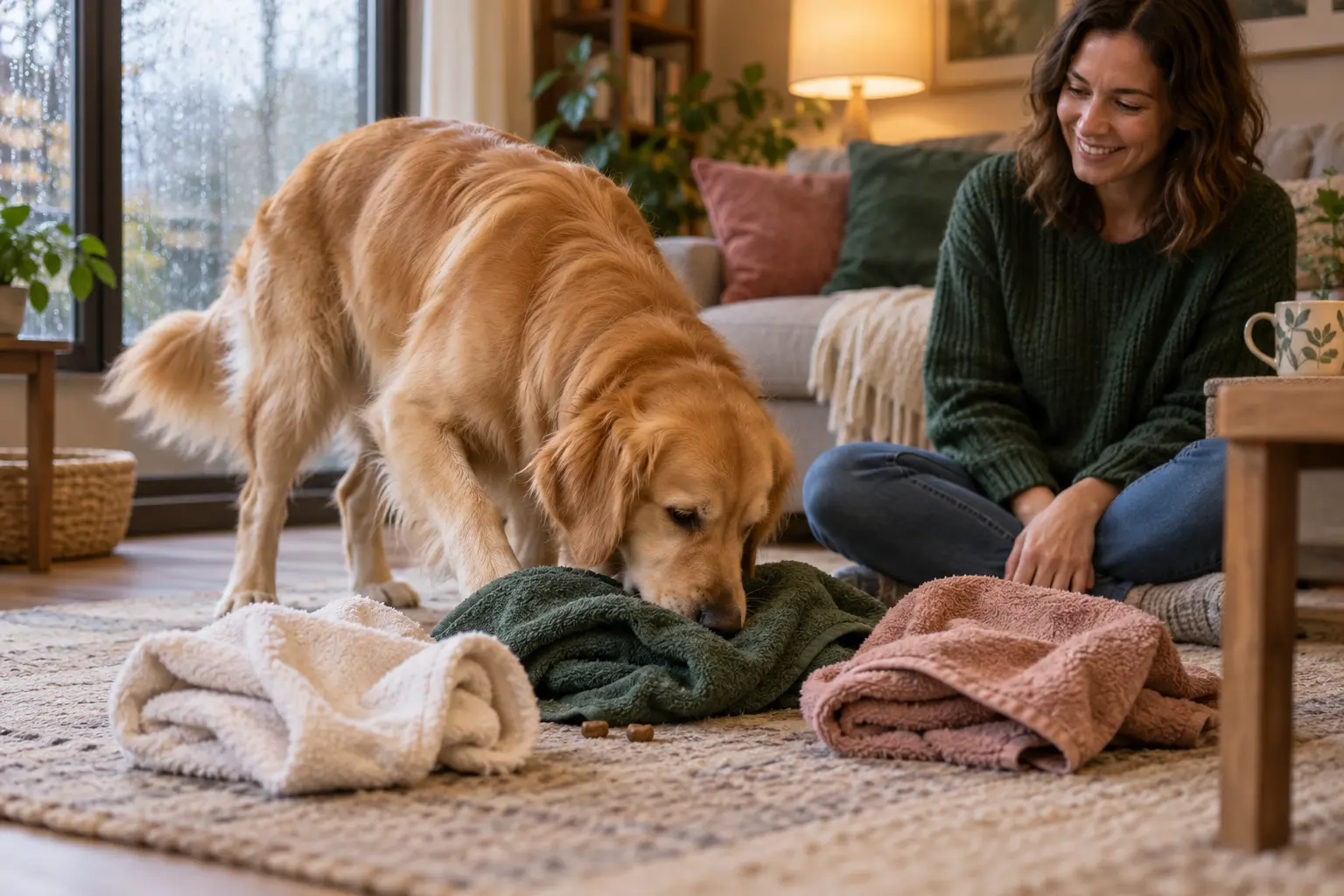
Start with a simple search on a clear, washable surface: place a few pieces of suitable food where the dog can easily find them while you supervise. You are learning whether this type of activity interests your dog, not building a complicated homemade device.
A towel search may suit some dogs but is a poor choice for dogs who eat fabric. Likewise, containers and loose household parts should not become chew items. Our rainy-day games guide offers other activities, including non-food options, so enrichment does not depend on one object.
If you later compare a commercial puzzle, look at its exact variant and included parts. A more complex board is not automatically better value. Begin with the design your dog can use comfortably and that you can supervise and clean.
Keep a tiny activity record
Use this reusable note: Activity: ___ · Setup: ___ · Food amount: ___ · Response: ___ · Next time: ___. For example: “Open compartments · Few pieces from usual food · Interested and gentle · Repeat before adding a closed compartment.”
Check the object for damage before the next session and clean it according to its instructions. Share the easiest successful setup with a sitter instead of handing over an unfamiliar puzzle with no explanation.
Next step: choose one simple supervised activity from the rainy-day guide. Buy a puzzle only if its design adds something useful to that routine.
Still deciding between designs? Our lick mat versus puzzle comparison explains the different activities and cleaning checks.