Updated
Start with a five-minute scent or training game using items you already own. Keep food portions small, remove anything your dog might swallow, and adapt the difficulty so your dog can succeed.
In this guide
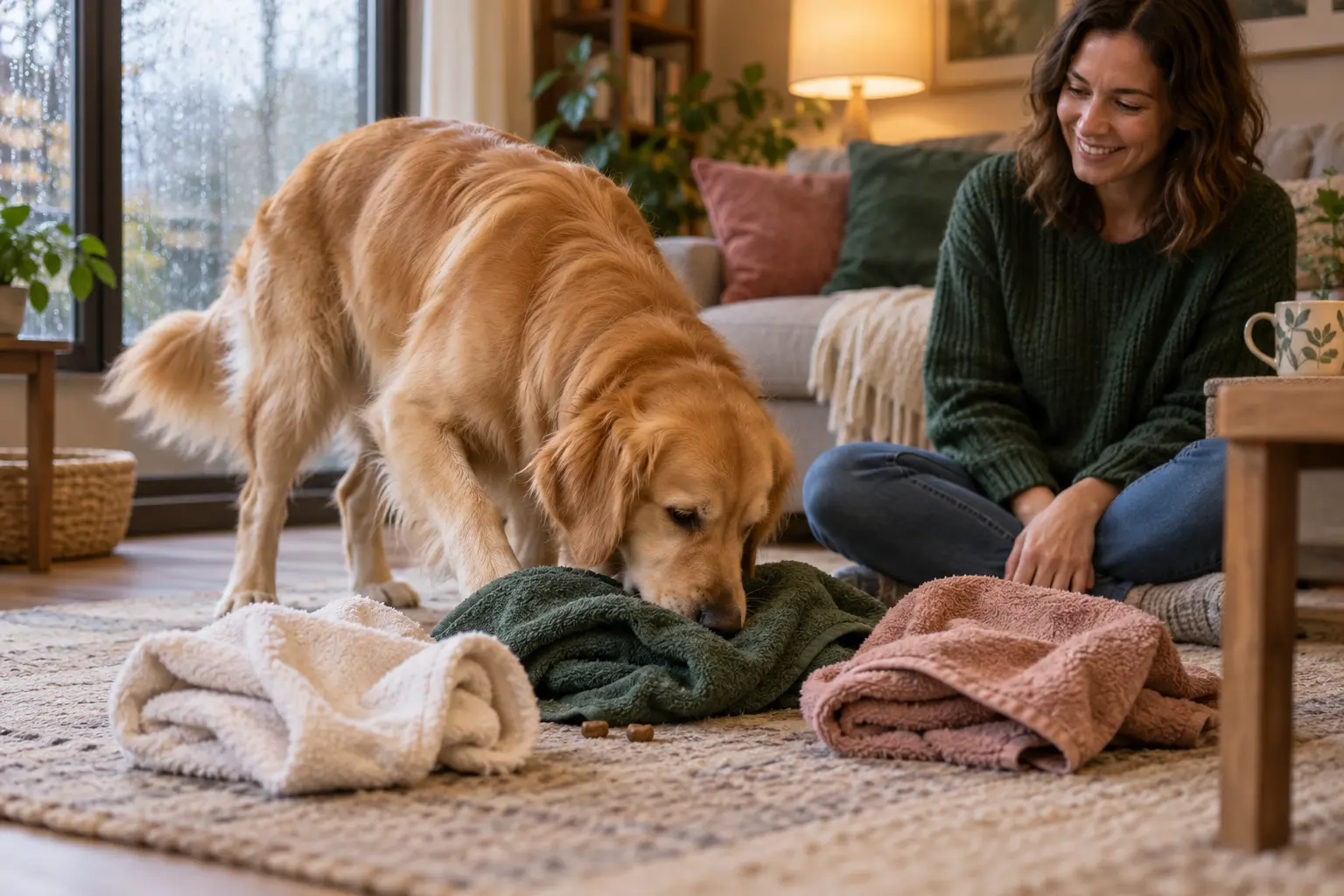
Start with these five easy games
- Towel treat search: spread a towel flat and place a few pieces of the normal food allowance on top. Let your dog eat those first, then fold one corner loosely over a piece. Keep the towel open enough for an easy success. Skip this game if your dog grabs or swallows fabric; never knot the towel.
- Find the toy: show one familiar toy, set it within sight and invite your dog to find it. Reward interest with praise or a brief game. Next time, put it just behind a chair leg while your dog watches. Do not hide it somewhere that requires climbing or squeezing behind furniture.
- Cup choice: put a piece of food beside one of two large cups first, then just under its edge. Reward sniffing at the right cup by lifting it yourself. Start without shuffling. End the game if your dog bites or paws forcefully at the cups; use a flat-floor search instead.
- Hide-and-seek: one person stays with the dog while another stands just around a nearby doorway. Call once and praise the dog for finding you. Make the hiding place a little less obvious only after several easy rounds. Keep stairs blocked and avoid startling your dog.
- Box search: set one clean, open cardboard box on the floor with food visible inside. Remove staples, tape and loose scraps first. Add a second empty box when your dog understands the game. For a dog worried by boxes, use a shallow tray or place food on the floor instead.
Keep the first attempt obvious. A brain game should create curiosity, not frustration. If your dog starts chewing or tearing the setup, calmly end the activity and choose a simpler option.
Choose your difficulty: visible reward first; one loose cover or one nearby hiding place next. Increase only one challenge at a time. A two-minute successful game is enough—there is no need to use all five minutes.
Source: ASPCApro: simple scent games and gradual searching challenges.
Ten more ideas for the rest of the month
- Name the toy: practise the name of one familiar toy instead of introducing several words at once.
- Hallway recall: take turns calling your dog a short distance between two people.
- Treat trail: place a few pieces of normal food in a short, visible trail that leads to a favorite mat.
- Muffin-tin puzzle: place food in a few wells and cover them loosely with dog-safe balls too large to swallow.
- Which hand? hold one treat in a closed fist and reward a calm nose indication.
- Toy tidy-up: reward one familiar toy placed into a low, stable basket.
- Beginner scent game: let your dog watch you place food in one of several open containers.
- Mat settle: reward calm moments on a familiar mat, gradually spacing the rewards.
- Gentle tug: use a suitable toy, pause often, and finish if teeth contact skin.
- Five-minute trick session: practise one known cue or one small new step, then stop.
Use the game—not the object—as the enrichment
- Supervise: towels, cups, boxes and toys are not safe for every dog to use unattended.
- Size: remove small pieces and anything your dog could swallow.
- Food: use part of the normal daily food allowance or suitable treats in small portions.
- Difficulty: make the first round easy and add only one challenge at a time.
- Comfort: stop if your dog appears worried, frustrated, tired or physically uncomfortable.
Dogs with resource guarding, food restrictions, pain or mobility concerns may need a different setup. Ask your veterinarian or a qualified behavior professional for individual guidance when needed.
A realistic rainy-day plan
New to food toys? Use our first food-puzzle guide to choose an easy setup and respond when a dog ignores, struggles with or chews the puzzle.
Fifteen useful minutes
- Five minutes of a scent game.
- A short bathroom break or movement break.
- Five minutes practising a familiar cue.
- Finish with calm time on a bed or mat.
You do not need to complete all 15 ideas in one day. Save the list, rotate two or three favorites, and note which activities leave your dog relaxed rather than overstimulated.
Do this first: put five pieces of your dog’s normal food into a loosely folded towel and supervise one easy search.